LINK recently published new research by Diffley Partnership examining how environmental issues might influence next year’s Holyrood election. Here are 4 things we learned from the poll.
- The environment matters to the voters who could decide the election.
As covered by the National and explored in my last blog, central to this research was an experiment which tested how voting intention would interact with different party positions on the environment.
The headline figures showed that both the SNP and Labour – as the two parties competing to form the next Scottish Government – would be likely to lose votes by pitching a “prosperity over climate action” approach.
The research used an innovative approach to test how winnable voters for different parties would respond to policy platforms with different levels of ambition on the environment. Respondents were shown a party platform that included the actual priorities of each party, with 1 out of 3 potential environmental messages.
This approach very clearly shows that, for the two parties vying to occupy Bute House, there is an electoral benefit to being seen to be strong on the environment – and a risk in adopting a more sceptical approach.
This is particularly notable due to the high overlap in potential supporters, with nearly half of those favourable to Labour also favourable to the SNP.
- On the environment, there are two clusters of voters around different parties.
Public opinion research very consistently shows that the Scottish public are deeply concerned about climate change and nature loss, with support for environmental action the mainstream position.
There is of course a minority of sceptics, including those who are outrightly hostile – 16% say that they disagree with stronger action to reduce climate emissions.
What our research shows is that, when asked about environmental issues, voters cluster into two distinct groups.
Environmental attitudes tend to be broadly similar among SNP, Labour and Lib Dem voters, and (unsurprisingly) particularly pronounced among Green voters. These groups have a high level of environmental concern and say that this will influence how they vote.
In contrast, Reform and Conservative supporters are outliers. They are more likely to be sceptical of climate action and less likely to say that environmental issues will determine how they vote.
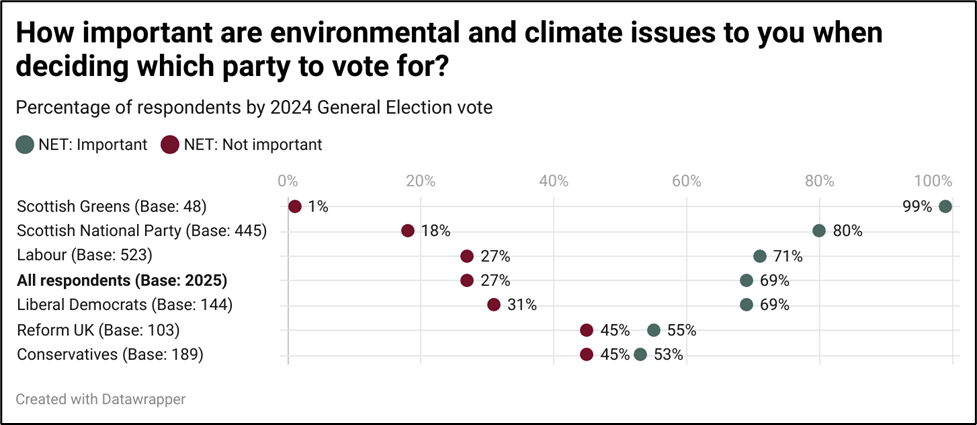
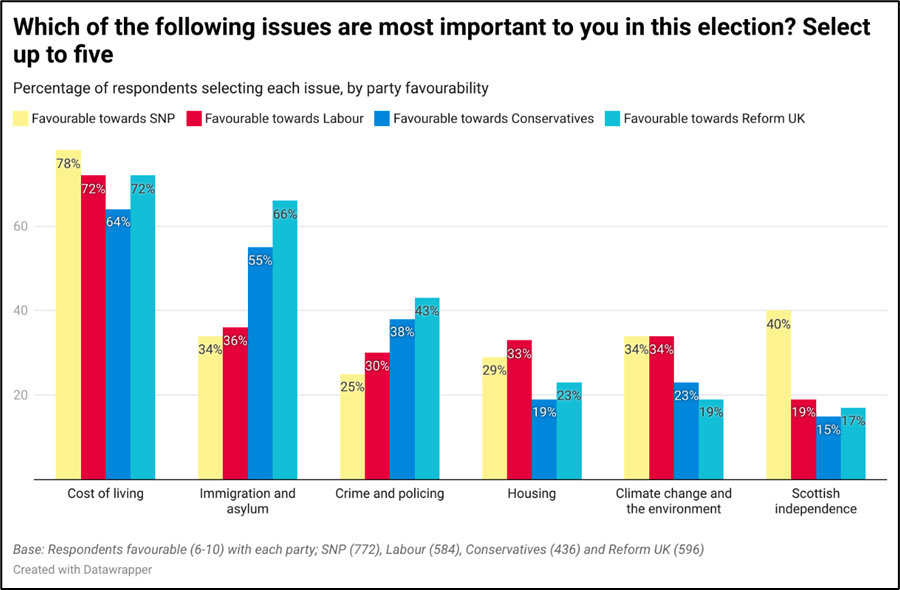
- Even for parties on the right, most potential voters support climate and nature action.
The clustering effect identified above shows that climate scepticism is concentrated among the right-wing parties. It is, however, a point that needs to be put into context.
Because while Reform and Conservative voters are certainly more likely to be sceptical of climate action, our research has found that the typical Reform or Conservative supporter actually supports emissions reduction. In fact, both groups support stronger climate action by two to one (Reform favourables: 53% agree, 25% disagree; Conservative favourables: 52% agree, 23% disagree).
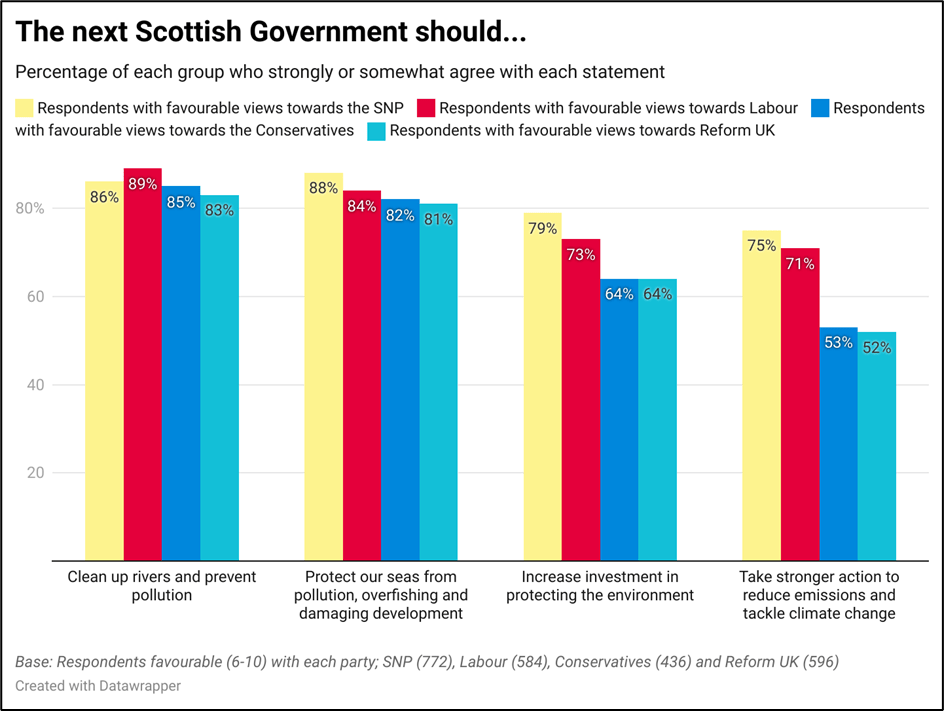
Support for wider environmental action among these voters is even stronger, with more than 4 in 5 of those favourable to Reform or the Conservatives supporting action to clean up rivers or protect our seas, and 64% of each group backing increased investment in environmental protection.
- Action to protect nature has wider support than emissions reductions – but both are overwhelmingly popular.
All of the pro-environmental policies which we polled were backed overwhelmingly by the public, with in most cases only tiny levels of opposition.
The public clearly value the natural world and want to see the next Scottish Government to take action on the environmental crises we face.
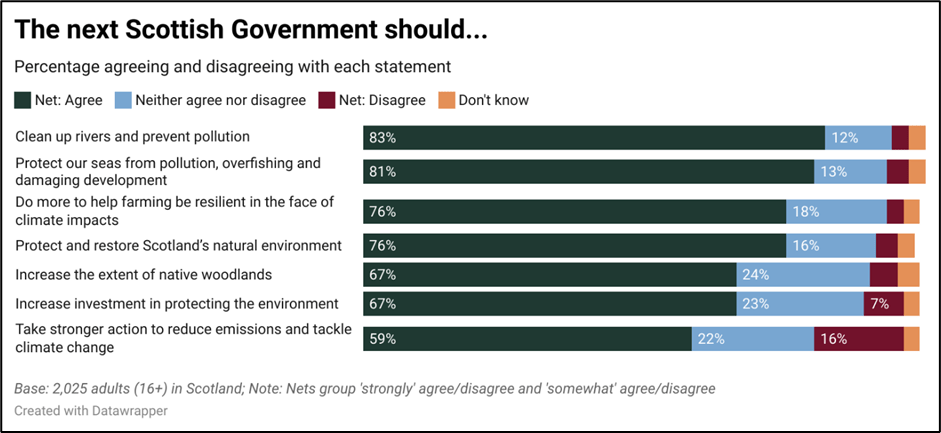
Despite the widely hyped climate backlash, support for stronger action on emissions remains very strong – and, as discussed above, is the majority position even among the potential voters of those parties most vocal in their opposition to Net Zero.
It is however notable that support for action on issues of nature and pollution is wider than support for climate action. The research does not explore why this gap might exist, but I expect the perceived interaction between climate policy and the cost of living is key. And there has of course been a sustained political and media campaign against the concept of Net Zero.
The lesson for policymakers is that leveraging high public concern over the natural environment, and speaking to our collective values, can help sustain support for climate action.
The full report is available on the Scottish Environment LINK website:
https://www.scotlink.org/publication/scottish-environment-link-measuring-public-attitudes-in-scotland-diffley-partnership/
 Dan Paris